
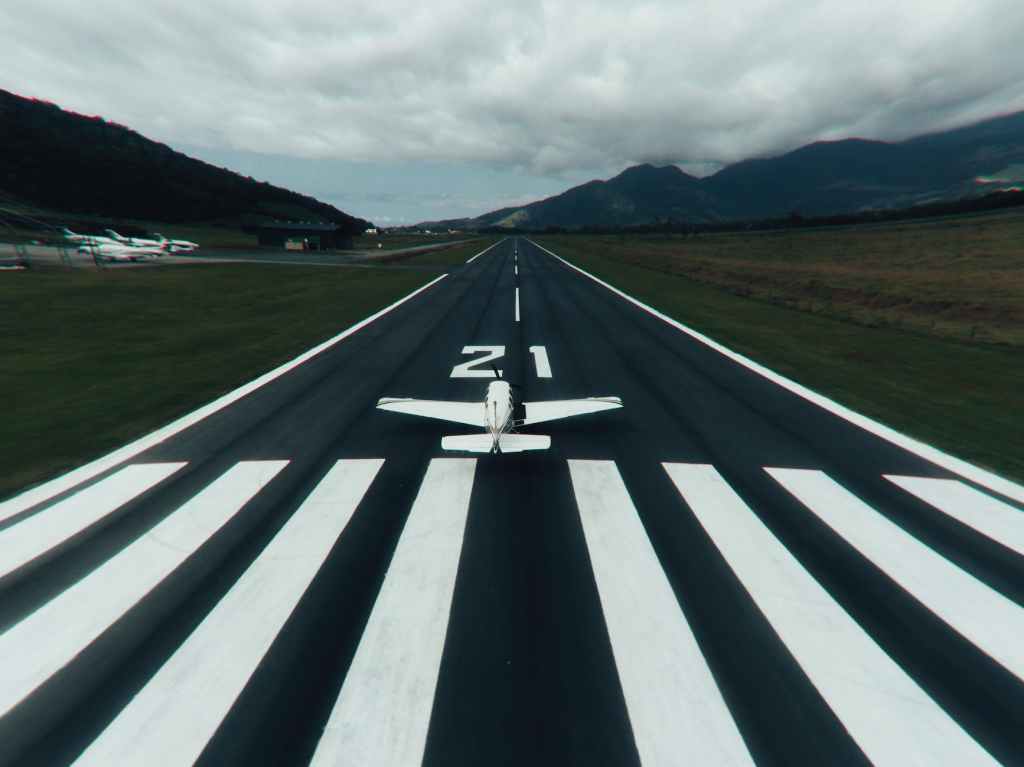
We’ve all seen it in any movie with a plane, at any airport, and in every video game, and I can guarantee you know their large, angular font, so today lets break it down. What are the numbers we see on runways and what exactly do they mean?
First, lets lay some ground rules. All runway numbers have two digits and they appear at the start of the runway they designate. So how do we choose those numbers?
It’s actually quite simple! The runway numbers are taken from the magnetic compass bearing of the runway. The direction that the runway faces on the 360° compass is recorded, and the last digit is dropped. So a runway with heading 170° would be assigned the number “17” and read “Runway one-seven). But immediately some issues stand out, for example, what if the runway heading isn’t a perfect multiple of ten? This case is simple. The runway heading is rounded to the the nearest azimuth of 10 degrees and that number is selected for the runway number.
These runway numbers are critical because they allow Air Traffic Control and pilots to easily communicate clearly about which runway they are referencing as they move about on the ground, and on
approach for landing. Pilots can quickly compare their heading to the runway number and ascertain that they are somewhat on the right track. And this is critical because every airport in the world has more than one runway. Okay… this is only half true if you think about a runway as a strip of asphalt, but if you consider runway numbers, then each one runway can have two headings, with one heading in the opposite
direction of the first. Going back to our Runway 17 example, aircraft landing or departing from the opposite side of the runway (on a heading of 350°) would be using Runway 35.
Phew okay we’re done, right? Not quite, because as you might know, most major airports have more than one runway. For some airports this is simple, such as La Guardia International (KLGA) with two runways, “14-22” and “13-31”. The runways face different directions and so all four different runway headings have different numbers. But many airports have two parallel runways. Lets look at Dubai Intl. Airport (OMDB).
Approaching from a heading of 120°, a pilot faces two runways both with the assigned number “12”. To distinguish between these, the runway on the left is 12 Left and the runway on the right is 12 Right. But from the opposite direction, for Runway 30 Left and Right, left and right would be switched. Hence OMDB has the runways 12L-30R and 12R-30L. Similarly, a center runway can be added for three parallel runways. This can be seen at Washington-Dulles (KIAD) with runways 1L-19R, 1C-19C, and 1R-
19L.
Then there is the famous KORD, Chicago O’Hare International. One of the busiest airports in the United States, it has no fewer than 9 separate runways, with 5 of them all oriented at 274.4°. So to fix the apparent problem, two of the runways were assigned 27L and 27R, while the other three received the designation 28L, 28C, and 28R. This solution of shifting runway numbers by 1 is common practice at any airport with more than three parallel runways. As if that’s not enough, runway numbers can change over time too! As the earth’s magnetic north
pole changes due to convection in the earth’s mantle, the runway’s original heading becomes misaligned with its actual magnetic heading, and runway numbers need to be reassigned and repainted. Fairbanks
International Airport in Alaska (PAFA) recently had its Runway 1L-19R renamed 2L-20R in 2009, and will likely have to change again in a few years as the magnetic field changes more.
Okay, that’s all for Runway Numbers, except for wind, by how aircraft use the wind, and how airport logistics support weather patterns and information, is enough for a post of its own.
 Hi-Tech hangar
Leave a comment