
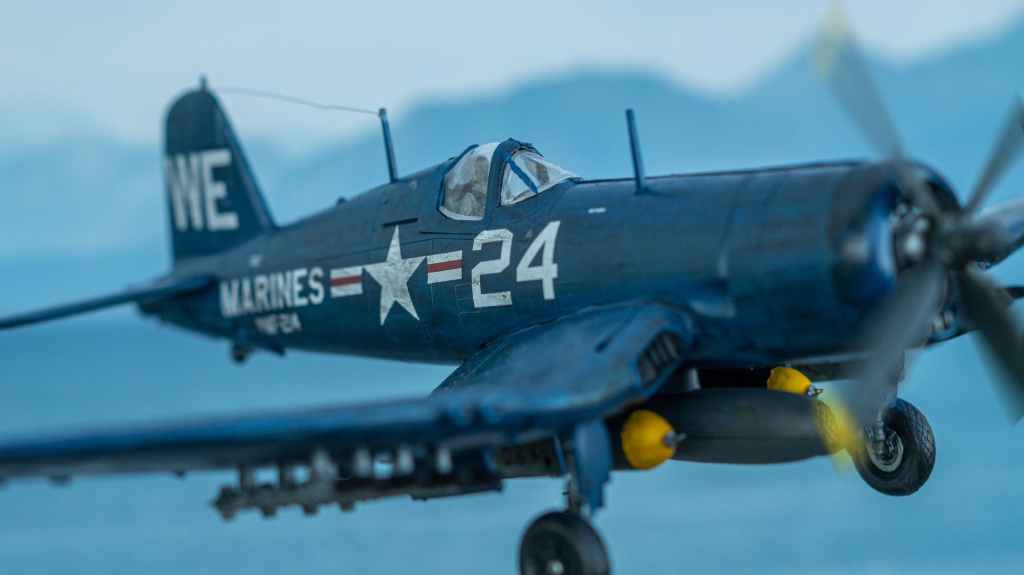
The Vought F4U Corsair is a fighter aircraft which was used mainly in World War Two and the Korean War. Initially designed and manufactured by Chance Vought, a company that speciallized in carrier launched aircraft with the Navy as their main customer, there was an instant demand and contracts were given to Goodyear and Brewster. These Corsairs are designated FG and F3A respectivley. This aircraft had the longest production run of any single-engined piston powered fighter aircraft in the United States Millitary, from 1943 to 1952.
Development of this exceptional fighter was led by Vought’s chief engineer, Rex Biesel, starting in 1938 and a prototype was ready by 1940. The aircraft has an unmistakeable inverted gull wing, designed to add extra height to the undercarriage in order to provide clearance for the monstrous 13-foot propeller. On its first flight, the Corsair flew in excess of 400 miles per hour, breaking the record for a single seat fighter aircraft. The Navy was convinced and immediately ordered production to begin. The F4U incorporated the largest available engine, the Pratt & Whitney R-2800 Double Wasp. It was an 18 cylinder radial engine also used on the F6F Hellcat.
Before entering operational use, many changes had to be made to the design of the F4U. A requirement for additional arnament forced the now six 50. caliber machine guns to be moved into the wings. The wing fuel tanks had to be moved into the fuselage, requiring the cockpit to be moved backwards and the fuselage extented. After these modifications, the position of the cockpit in the rear coupled with the large nose made carrier landings difficult for novice pilots. Additionally dangerous stall characteristics, leaking oil, and oleo struts in the landing gear with bouncing characteristics delayed its introduction to carrier use. In the meantime, the F6F had passed its carrier trials with the Navy and had been adopted into carrier use. The F4U was instead given to the Marines, who operated the F4U from land bases in the Pacific to devastating effect. Once bleed valves were added to the landing gear, engine cowlings were locked down to prevent oil splattering, and a genious tactic was made in which a pilot approached the carrier in a turn in order to have better visibility, the F4U was finally cleared for carrier operation in April of 1944 and entered widespread use shortly thereafter.
The first combat action the F4Us faced was with Marine squadron VMF-124, operating out of Guadacanal but they didnt have real success until March of 1944, when they shot down eight Japanese A6M Zeroes in a sortiee over Ponape. Corsairs operating from land bases sometimes had their arrestor hooks(necessary for carrier landings) removed and bombs, rockets, and napalm could be added. VMF-124 was the first carrier-based Cosair squadron in December of 1944. Many Corsairs were also delivered to the Royal Navy and the Royal New Zealand Air Force. By the end of the second world war, the Corsairs had racked up an impressive 11:1 kill ratio. In the Korean War, the F4U was mainly used as a close air support aircraft rather than a fighter. It saw its last combat operation in 1969 as part of the so called “Football War” between Honduras and El Salvador.
 Hi-Tech hangar
Leave a comment